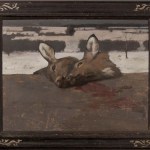
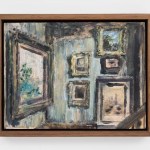
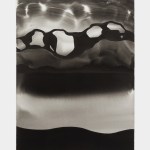
Contributed by Matthew Logsdon / Upon entering “Leech,” Kari Cholnoky’s third solo exhibition at Nicelle Beauchene Gallery, one of the first sculptures encountered is Conservation of Mass, a cranial-like form of smooth, peach-colored alabaster atop a steel pedestal. It is vertically symmetrical, with the most protruding elements centered like noses, creating a ribbed topography of ridges and recesses that suggest a face. The casual viewer is afforded just enough space between the sculpture and the wall to peek around the back of the piece but not enough to see it from eye level. An especially bold and engaged visitor, though, would find a wisdom tooth resting within a fleshy cavity. Is this the physical record of bodily alteration? Part of a strategy of removing superfluous body parts? Conservation of Mass embodies mortal life: confrontation, cat and mouse, meat and bone. There’s acknowledgment that sometimes something needs to be cut out to salvage the whole.
Solo Shows
Eric Wolf: Into the fog
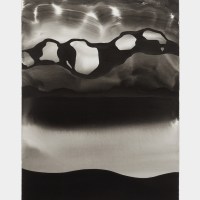
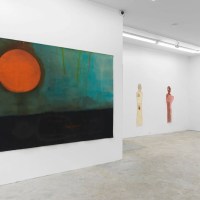
Contributed by Sharon Butler / Few artists – even among those dedicated to the landscape – would look at a body of water and think, “OK, I’m going to spend the next 30 years painting this.” Yet, year by year, Eric Wolf has done just that, driven by a fascination with the daily transformation of water’s surface, its complementary relationship to air, its connection with people, and the peculiarly seductive power of black ink on paper. “Two Waters,” on view at Abri Mars, spans three decades of Wolf’s en plein air ink painting, which he did exclusively at two sites: a pond in Chatham, New York, and a lake in Rangeley, Maine.
E.M. Saniga: Country life vigorously observed
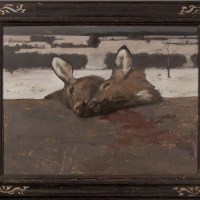
Contributed by Sutton Allen / With his show at Donald Ryan Gallery, E.M. Saniga join the esteemed company of artists who have eschewed fashion for the sake of personal vision. His real kin are Albert Pinkham Ryder and Courbet. He and Courbet are both interested in the raw beauty of country life yet also share an urbane sensibility. Saniga’s experience is made tactile through carefully modeled half tones and a calculated and surprising facture.
Ken D. Resseger: Closer to creation
Contributed by Michael Brennan / In blues, there’s a tradition of over-practice, the idea being that the same song played thousands of times, and thus mastered, might yield something new about its nature, revealing a hidden room. My own artistic bias has long been to err on the side of underdevelopment. Ken Resseger, who was a student of mine over 25 years ago, back then overpainted. But, while his work could be labored, it often opened an entirely new world. As an older, seasoned painter, he has become something of a visionary in the very American vein of Martin Johnson Heade – a naturalist who painted exotic, realistic, yet unnatural landscapes.
Ruby Palmer: Flowers are forever
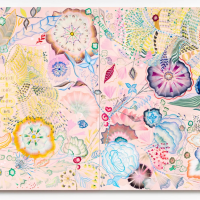
Contributed by Peter Schroth / Some subjects are immune to age or aesthetic trends. Like the sprout that powers through the crack in the sidewalk, plant life in general and flowers in particular are irrepressible inspirations for art and have breached the territories of artists primarily known for other, more rigorous forms, from Piet Mondrian to Amy Sillman. Ruby Palmer’s show “Garden Theory” at Morgan Lehman Gallery demonstrates yet again that flowers are forever.
Sam Jablon’s delicious confusion
Contributed by William Corwin / The paintings of Sam Jablon now on view at Morgan Presents produce delicious sentient confusion. The neural circuits devoted to looking at an image get crossed with those used to read text. We find the words, but, in Jablon’s hands, we don’t know what to do with them. Fuck, for example, a little 18-inch square painting in solid yellow with blue with black lettering, seems less about sex and more about the frustrated expletive. Or perhaps it’s a cold command, broken down into two letters on top, F and U, and two letters below, C and K. We also fix…
Elisa Jensen’s expansive interiors
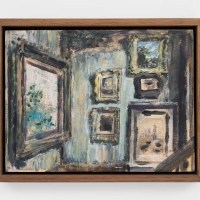
Contributed by John Goodrich / Is it possible for a painter to celebrate both the traditions of great painting and her own spontaneously observed surroundings? […]
Opal Mae Ong: Worlds weighing in
Contributed by Lucas Moran / “Always Were” is the title of Opal Mae Ong’s solo show at Plato Gallery. It’s a compact declaration – two words that look both forward and back. The work does the same. Old ways, rituals, medicines, and inherited knowledge blur into future or parallel worlds: gradient skies without brushstrokes, glowing plants, and figures who bathe, offer, watch, and mourn. Grief is a constant presence here – not as melodrama but as a condition with the same dignity and value as joy or love. Ong treats all of it as coexistent. Nothing replaces anything.
Barbara Takenaga’s pinballing fantasia
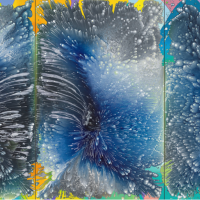
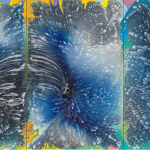
Contributed by Peter Schroth / Barbara Takenaga’s current exhibition at DC Moore, “Parallax,” picks up from her 2024 exhibit “Whatsis” and continues an arc roughly twenty years in the making. The works are acrylic on canvas and panel and range from diminutive rectangles to monumental multi-paneled pieces.Takenaga iterates her signature techniques of pouring and handwork seamlessly, in a lead-and-follow approach that balances randomness, intuition, and calculation.
Lois Dodd: A balm against cynicism
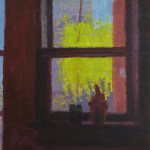
Contributed by David Whelan / I first saw a Lois Dodd painting in 2004. View through Elliot’s Shack Looking South was part of a group show at our college gallery when I was a freshman. The painting absolutely stunned me and served as a touchstone throughout my education and early adulthood. Dodd’s solo show “A Radiant Simplicity” at The Art Gallery at Brooklyn College might have done the same for others.
Amelie Mancini: Longing and wonder
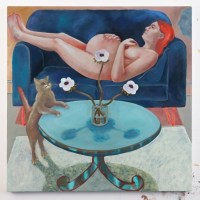
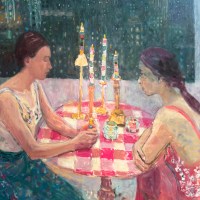
Contributed by Caroline Otis Heffron / Amelie Mancini’s debut solo exhibition at Massey Klein Gallery, offers poignant reflections on women, enticing viewers with harmonious colors and intricate patterns that initially convey a sense of contentment and balance. But her layering techniques, involving translucent paint, and repeating motifs – reminiscent of Vuillard, Matisse, and Modersohn-Becker – encourage closer study of gesture and expression. As the viewer moves in, archetypal faces emerge with expressions of longing and wonder, leaving ambivalence.
Tracy Burtz and Claire McConaughy: Vulnerability and resilience at The Painting Center
Contributed by Elizabeth Johnson / Two solo exhibitions at The Painting Center, Claire McConaughy’s “Uncultivated” and Tracy Burtz’s “What She Knows,” respectively present external and internal versions of powerful female spaces, generating an unexpected synthesis.
Mira Schor: Uncensored
Contributed by Jonah James Romm / How does one acquire language? How do words shape identity and meaning? These questions might strike you upon entering Mira Schor’s exhibition “Figures of Speech” at Lyles & King. Bringing together a previously unseen body of the artist’s work from the 1980s and paintings from the last two years, the exhibition traces the compelling self-referential progression of Schor’s work over the last four decades.
Kate Hargrave: Unsettling and generous
Contributed by Lore Heller / “MILK TEETH,” the title of Kate Hargrave’s show at Karma, implies both permanent loss and permanent gain. One gains milk teeth as a baby and loses them as adult teeth take their place. If children place them under their pillows, fairies might bring rewards. Losing milk teeth is losing childhood, developing permanent teeth coming of age – reminders to parents that time inexorably arcs life. Joni Mitchell observed that “we’re captive on the carousel of time,” and my grandmother’s lullaby, “toyland, toyland, beautiful boy and girl land,” reminds us that “once you cross its borders you may never return again.” Hargrave, who painted this work as she raised two children, captures this pervasively bittersweet quality.
Felix Beaudry’s malleable boys
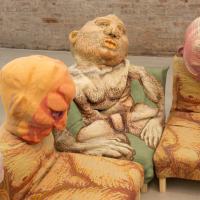
Contributed by Bill Arning / There is something wildly compelling when an installation flips on you—reversing itself in meaning and affect if you linger more than five minutes. Felix Beaudry’s “Malleable Boys” at Situations is one of those shows. On first entry, oversized, lumpy, monstrous heads loom and encircle you like funhouse demons. They feel nightmarish—deformed, melting, mid-metamorphosis into dangerous humanoid creatures. But stay a beat longer and the menace softens. They become almost cute, like huggable, overgrown Cabbage Patch Kids—less terrifying than misunderstood.