Contributed by Bill Arning / Long-time Bosman watchers often recall his work as a firehose of imagery—gunfights and car chases, sinking ships, kidnappings, and robberies pouring out in rapid succession. Fans might therefore be surprised when entering his first solo show at Kingston’s beloved Headstone Gallery, a venue known for its ambitious program of younger artists. In inviting an older master like Bosman, the gallery has delightfully broadened its scope.
Search Results for "label/Time Out"
How the term “zombie formalism” killed the next generation
Contributed by Sharon Butler / In 2014, a single phrase reshaped the trajectory of contemporary abstract painting. When the late Walter Robinson – painter, critic, and veteran of the Pictures Generation – coined the derogatory term “zombie formalism” in an essay for Artspace, he set off a chain reaction that would stigmatize a generation of young abstract artists and cast a long shadow over abstraction in general. More than a decade later, the story of zombie formalism reads as a pungent example of aesthetic cynicism and jadedness – a case study in how criticism, commerce, and cultural anxiety can converge to distort and ultimately damage an entire movement.
Maureen Dougherty’s collectors: Pride without greed
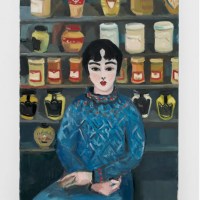
Contributed by Natasha Sweeten / Maureen Dougherty brings her paintings to life with quiet assurance. For “The Completionists,” her current exhibition at Mendes Wood DM in Germantown, she presents portraits of solitary collectors showcasing their collections in muted yet elegant tones not unlike Luc Tuymans’, with dabs of paint nestled into shadows and on tips of asparagus. Objects such as dog figurines, serving dishes, Picasso’s ceramics, skulls, and books are dutifully balanced on horizontal bands of shelving stretching across the picture plane, providing a fixed compositional framework. Perhaps Dougherty’s years of working in abstraction cultivated the acuity and freedom in her brushstroke. Nearly every one of the nine paintings on view fills the expanse of canvas as if to suggest that we’ve zoomed in on a larger presentation, singling out this particular person with this particular array of belongings while also understanding the moment as memory.

Diebenkorn at Gagosian: A remarkable curatorial accomplishment
Contributed by David Carrier / For a long time, I have always thought of Richard Diebenkorn as a great painter. A couple of his paintings were in my local museum, the Carnegie Museum of Art in Pittsburgh, where I treasured seeing them. But he was, so I believed, someone whose development was straightforward, even a little boring. I arrived at Gagosian’s large upstairs gallery on Madison Avenue with low expectations of a thick array of Diebenkorns in that one room. Maybe it had been a mistake, inspired by misguided nostalgia, to take on this assignment. In the event, the exhibition was revelatory, holding me spellbound. This is one reason why I love being an art critic – the surprise.
LA PST Report: Toward better social behavior
Contributed by Peter Plagens / The first edition of the Getty-sponsored “Pacific Standard Time” slate of exhibitions in 2011 was subtitled simply “Art in L.A., 1945 – 1980,” and it aimed to elucidate Southern California’s contribution to American postwar modern art. In 2017, the second iteration was called “LA/LA,” indicating the city’s Latin American art and artists. This time around PST has declared a more specific theme, “Art and Science Collide,” reminiscent of one of those noble Rose Parade rubrics…
Past, present, and future: The complementary visions of Jodi Hays and Michi Meko
Contributed by Jenny Zoe Casey / In a fascinating and inspired pairing, “The Burden of Wait” at Susan Inglett brings together painters Michi Meko and Jodi Hays and explores the different ways in which inhabitants of a particular region – here the American South – can experience it. Landscape is an important influence for both artists, but their approaches are mostly in opposition.
Trade secrets: How much should a painter reveal?
Contributed by Bonnie Morano / I consider myself an open book. The secret ingredient to my zesty salad dressing is cumin. Avoiding parking tickets in NYC involves a finely worded note on the windshield. But ask me how I get my oil paint to stay so shiny when dry, I hesitate….In this social media age of oversharing, does the aura of the heroic painter today rest on magic and mystery or up front transparency?
Elisabeth Condon: Beautiful complexity
Contributed by Sharon Butler / To understand Elisabeth Condon’s paintings, it seems important to know that she grew up in California in a highly decorated house where she spent hours staring at the wild patterns of the fabrics and wallpapers. The experience certainly informs her exuberant paintings, in which pattern, flower, landscape all co-exist, as she says in her artist statement, in living, breathing presence.
Lisa Hoke’s unconfined vision
Restricted to her studio during lockdown and cut off from large spaces in which to create site-specific work, Lisa Hoke felt the need to fashion pieces that were more portable and more presumptively permanent. What resulted is a scintillating revelation.
Armin Kunz: Presentism and art history
Contributed by Armin Kunz / �Can we ever look at Titian�s paintings the same way again?� asked Holland Cotter when he reviewed the reunion of […]
Surface, flourish, complexity at the Hessel Museum
Contributed by Anne Swartz / Since its origins in the 1970s, practitioners and advocators of the Pattern and Decoration movement have countered claims that decorative art lacked seriousness. In America at the time, critical arguments focused on the exhaustion of painting, positioning it as an outmoded visual form. Several artists resisted this affront. Instead, they embraced images for their pleasure, opposing the notion of immediacy often considered synonymous with other mediums such as photography.
Les Gommes: Becky Brown and Annette Cords at PS122
Contributed by Axel Bishop / In a collaboratively constructed two-person exhibit at PS122, Brown and Cords experiment with the interplay of image-experience vs. knowing through written language.
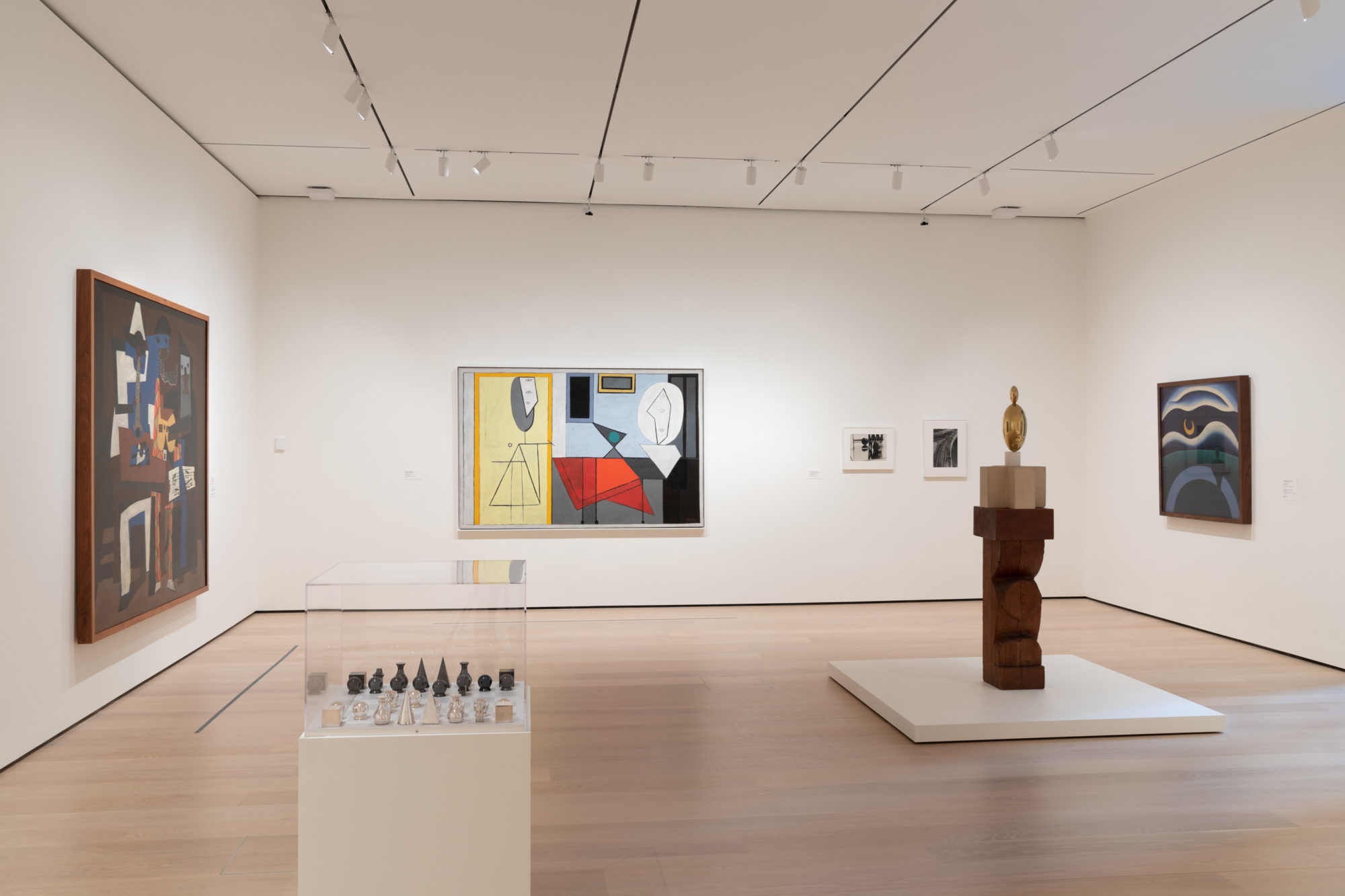
The stories we choose to tell: “Fall Reveal” at MoMA
Contributed by Laurie Fendrich / The Museum of Modern Art�s �Fall Reveal� marks the second phase of the museum�s re-telling of the story of Modern […]
Finding Esphyr Slobdokina
Contributed by Peter Plagens / When the annual The Armory Show art fair — which takes place on the piers on the Hudson River in […]
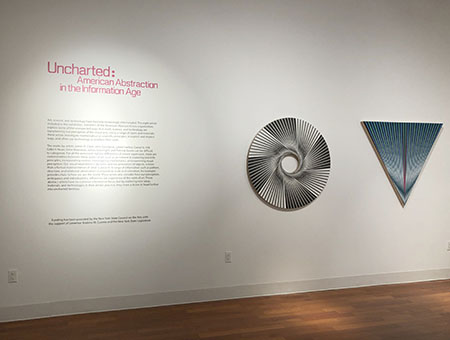
Catalogue essay: Abstract Art Does Not Stop an Hour
Contributed by Laurie Fendrich / The works in Uncharted: American Abstraction in the Information Age are, for all their reliance on what we call “technology,” […]
Catalogue essay: Paul Pieroni on Peter Halley’s 1980s painting
The aim of this text, which was originally published as “Facts are Useless in Emergencies” in Peter Halley: Paintings of the 1980s The Catalogue Raisonne, […]
Vija Celmins: To fix the image in memory
Contributed by Laurie Fendrich / Anyone walking out of the Vija Celmins retrospective that opened last week at SFMoMA thinking how good she is at […]
Exhibition essay: Sarah Sentilles on Nancy Bowen at Kentler International Drawing Space
Contributed by Sarah Sentilles / Nancy Bowen calls herself an “artistic archaeologist,” and in her exhibition “For Each Ecstatic Instant,” you can see the fragments […]
Carter Ratcliff: Art in the age of Trump
Contributed by Carter Ratcliff / Let�s begin with a painting�not sure it�s a work of art�that could have been painted only now, during Trump�s presidency. This […]
Rainy day in New York
When I got to the studio this dreary grey morning, my coat and tote bags were sopping wet. Looking up from the building’s entrance on […]