Search Results for "label/The Metropolitan Museum"

Museum Exhibitions

Paul Klee, degenerate for the ages

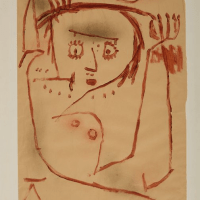
Contributed by Jonathan Stevenson / Branded a degenerate artist for his “insane childish scrawling” by the Nazis, Paul Klee, once anointed at the Bauhaus, left Germany for Switzerland in 1933. Scleroderma was already affecting his will and ability to paint, and his theretofore prodigious output waned. But as Germany’s onslaught in Europe effloresced into World War II, he regained purpose and productivity, yielding over 1,250 works in 1939, the year before his death. During this period, he downplayed his signature sublimation via color in favor of succinct line to expose the toxicity of fascism. Everything that concerned him as a citizen of the world seemed to catch light in his art. This valedictory turn is the subject of “Other Possible Worlds,” the Jewish Museum’s superbly curated show, uniquely centered on his final decade. 
Museum Exhibitions

The new Frick: A somewhat sentimental reaction

Contributed by David Carrier / Rebuilding seems to be a cyclical occurrence for older art museums. The collection expands, styles of display change, more capacious restaurants and shops may be needed. Older museums have to construct new galleries. To the original European galleries, entered atop the stairs at the entrance, the Metropolitan Museum of Art added space for Islamic art, contemporary work, and Asian paintings. Alternatively, a wealthy museum can rebuild almost from scratch, as MoMA has repeatedly done. Yet, for most of the time I have been going to art museums, New York’s Frick Collection has been basically unchanged, an island of stability. I remember once being shocked that one of its masterworks – Rembrandt’s The Polish Rider – was away on loan. No other major New York art institution has remained basically the same over such a lengthy period, celebrating idiosyncratic displays that mix sacred and secular works in a luxurious setting. Henry Clay Frick had a great eye. 

Solo Shows

Diebenkorn at Gagosian: A remarkable curatorial accomplishment 

Contributed by David Carrier / For a long time, I have always thought of Richard Diebenkorn as a great painter. A couple of his paintings were in my local museum, the Carnegie Museum of Art in Pittsburgh, where I treasured seeing them. But he was, so I believed, someone whose development was straightforward, even a little boring. I arrived at Gagosian’s large upstairs gallery on Madison Avenue with low expectations of a thick array of Diebenkorns in that one room. Maybe it had been a mistake, inspired by misguided nostalgia, to take on this assignment. In the event, the exhibition was revelatory, holding me spellbound. This is one reason why I love being an art critic – the surprise.