Contributed by David Carrier / Significant twentieth-century artists occasionally depicted flowers. Andy Warhol was one, Ellsworth Kelly another. But it’s hard to think of any major painter today who focuses predominantly on them. Rachel Ruysch (1664–1750) lived in a very different world. Thanks to the bountiful worldwide empire of Golden Age Holland, even this stay-at-home painter could obtain an amazing variety of imported flowers. The Toledo Museum of Art’s “Nature into Art,” drawn from her 150 surviving works, is, improbably, the first major exhibition devoted to her. Botany thrived in Ruysch’s time due in part to Dutch imperialism. Flower painting became a major artistic genre, and she and her rivals enjoyed access to an enormous variety of exotic flowers (and insects). Critics rightfully consider her pre-eminent. “At her best,” the catalogue says, “Ruysch painted like a novelist, creating scenes within a framework at large.“ Indeed, her intricately crafted, remarkably varied paintings convey the story of Dutch capitalism.
Search Results for "label/The Age"
Ted Stamm’s conceptual adventurism
Contributed by Saul Ostrow / When Ted Stamm’s career was cut short by his death at age 39 in 1984, he had already begun to attract attention in the United States and internationally. Critics including Edit deAk, Peter Frank, Robert Morgan, and Kay Larson recognized Stamm’s ability to bridge formal rigor with playful urban references. In 1975, deAk wrote in Artforum that “Stamm’s work confounds its own apparent simplicity; the shape’s tense complexity and stubborn definition of itself make it totally the artist’s like an insignia. The color is equally personal, and the painting’s presence is quietly assertive. This is certainly not the elegant nihilism of reductive solutions.” Conceptual endeavors were central to his ambition of making the border between art and everyday life porous.
Trade secrets: How much should a painter reveal?
Contributed by Bonnie Morano / I consider myself an open book. The secret ingredient to my zesty salad dressing is cumin. Avoiding parking tickets in NYC involves a finely worded note on the windshield. But ask me how I get my oil paint to stay so shiny when dry, I hesitate….In this social media age of oversharing, does the aura of the heroic painter today rest on magic and mystery or up front transparency?
Lisa Hoke’s unconfined vision
Restricted to her studio during lockdown and cut off from large spaces in which to create site-specific work, Lisa Hoke felt the need to fashion pieces that were more portable and more presumptively permanent. What resulted is a scintillating revelation.
Surface, flourish, complexity at the Hessel Museum
Contributed by Anne Swartz / Since its origins in the 1970s, practitioners and advocators of the Pattern and Decoration movement have countered claims that decorative art lacked seriousness. In America at the time, critical arguments focused on the exhaustion of painting, positioning it as an outmoded visual form. Several artists resisted this affront. Instead, they embraced images for their pleasure, opposing the notion of immediacy often considered synonymous with other mediums such as photography.
Catalogue essay: Abstract Art Does Not Stop an Hour
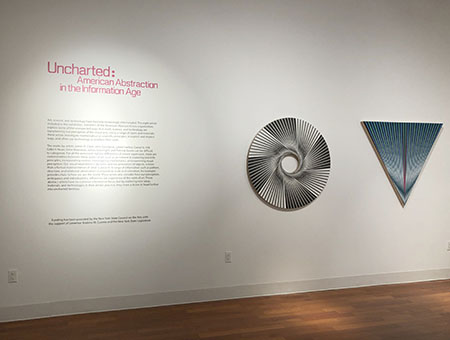
Contributed by Laurie Fendrich / The works in Uncharted: American Abstraction in the Information Age are, for all their reliance on what we call “technology,” […]
Catalogue essay: Paul Pieroni on Peter Halley’s 1980s painting
The aim of this text, which was originally published as “Facts are Useless in Emergencies” in Peter Halley: Paintings of the 1980s The Catalogue Raisonne, […]
Carter Ratcliff: Art in the age of Trump
Contributed by Carter Ratcliff / Let�s begin with a painting�not sure it�s a work of art�that could have been painted only now, during Trump�s presidency. This […]
Interview: Daniel Kingery in Hunt’s Point
Contributed by Rob Kaiser-Schatzlein / The four paintings I looked at in Daniel Kingery‘s Bronx studio are all medium-sized, human scale. Paint application strategies vary […]
Responses to “Zombie Formalism”
My last post precipitated several comments about Walter Robinson’s term “Zombie Formalism” and about the type of work discussed, as well as some offline discussion […]