Contributed by David Carrier / Rebuilding seems to be a cyclical occurrence for older art museums. The collection expands, styles of display change, more capacious restaurants and shops may be needed. Older museums have to construct new galleries. To the original European galleries, entered atop the stairs at the entrance, the Metropolitan Museum of Art added space for Islamic art, contemporary work, and Asian paintings. Alternatively, a wealthy museum can rebuild almost from scratch, as MoMA has repeatedly done. Yet, for most of the time I have been going to art museums, New York’s Frick Collection has been basically unchanged, an island of stability. I remember once being shocked that one of its masterworks – Rembrandt’s The Polish Rider – was away on loan. No other major New York art institution has remained basically the same over such a lengthy period, celebrating idiosyncratic displays that mix sacred and secular works in a luxurious setting. Henry Clay Frick had a great eye.
Search Results for "label/Rose Art Museum"
Rachel Ruysch: Late bloomer
Contributed by David Carrier / Significant twentieth-century artists occasionally depicted flowers. Andy Warhol was one, Ellsworth Kelly another. But it’s hard to think of any major painter today who focuses predominantly on them. Rachel Ruysch (1664–1750) lived in a very different world. Thanks to the bountiful worldwide empire of Golden Age Holland, even this stay-at-home painter could obtain an amazing variety of imported flowers. The Toledo Museum of Art’s “Nature into Art,” drawn from her 150 surviving works, is, improbably, the first major exhibition devoted to her. Botany thrived in Ruysch’s time due in part to Dutch imperialism. Flower painting became a major artistic genre, and she and her rivals enjoyed access to an enormous variety of exotic flowers (and insects). Critics rightfully consider her pre-eminent. “At her best,” the catalogue says, “Ruysch painted like a novelist, creating scenes within a framework at large.“ Indeed, her intricately crafted, remarkably varied paintings convey the story of Dutch capitalism.
LA PST Report: Toward better social behavior
Contributed by Peter Plagens / The first edition of the Getty-sponsored “Pacific Standard Time” slate of exhibitions in 2011 was subtitled simply “Art in L.A., 1945 – 1980,” and it aimed to elucidate Southern California’s contribution to American postwar modern art. In 2017, the second iteration was called “LA/LA,” indicating the city’s Latin American art and artists. This time around PST has declared a more specific theme, “Art and Science Collide,” reminiscent of one of those noble Rose Parade rubrics…
Helen Frankenthaler: More profound than lyric
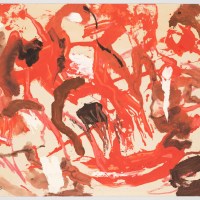
After seeing the exhibition at Gagosian, I’ve become a huge Helen Frankenthaler fan. Curated by John Elderfield, Chief Curator Emeritus of Painting and Sculpture […]