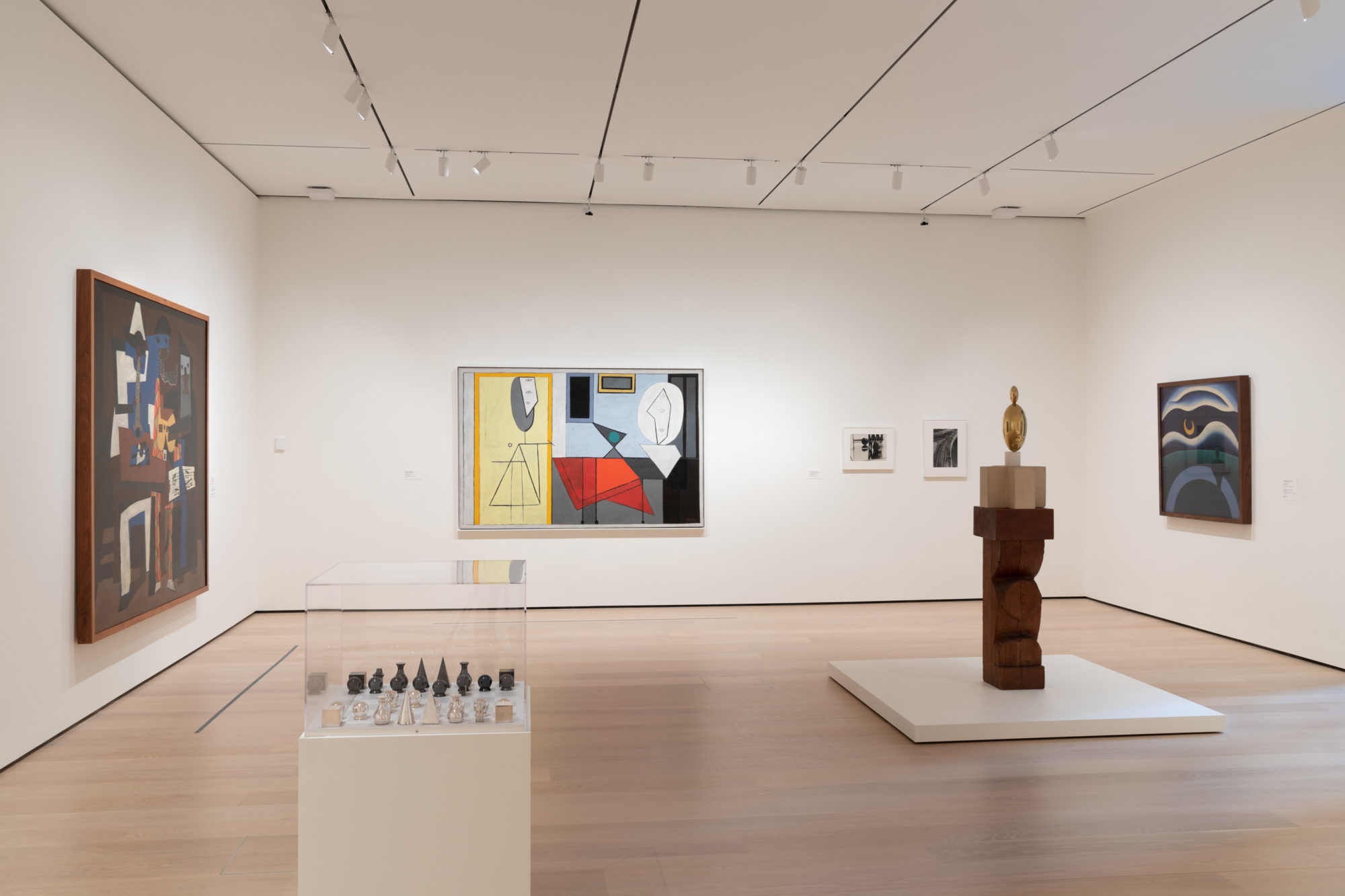
Contributed by David Carrier / Rebuilding seems to be a cyclical occurrence for older art museums. The collection expands, styles of display change, more capacious restaurants and shops may be needed. Older museums have to construct new galleries. To the original European galleries, entered atop the stairs at the entrance, the Metropolitan Museum of Art added space for Islamic art, contemporary work, and Asian paintings. Alternatively, a wealthy museum can rebuild almost from scratch, as MoMA has repeatedly done. Yet, for most of the time I have been going to art museums, New York’s Frick Collection has been basically unchanged, an island of stability. I remember once being shocked that one of its masterworks – Rembrandt’s The Polish Rider – was away on loan. No other major New York art institution has remained basically the same over such a lengthy period, celebrating idiosyncratic displays that mix sacred and secular works in a luxurious setting. Henry Clay Frick had a great eye.
Search Results for "label/New York galleries"
Diebenkorn at Gagosian: A remarkable curatorial accomplishment
Contributed by David Carrier / For a long time, I have always thought of Richard Diebenkorn as a great painter. A couple of his paintings were in my local museum, the Carnegie Museum of Art in Pittsburgh, where I treasured seeing them. But he was, so I believed, someone whose development was straightforward, even a little boring. I arrived at Gagosian’s large upstairs gallery on Madison Avenue with low expectations of a thick array of Diebenkorns in that one room. Maybe it had been a mistake, inspired by misguided nostalgia, to take on this assignment. In the event, the exhibition was revelatory, holding me spellbound. This is one reason why I love being an art critic – the surprise.
Richard Bosman at Headstone Gallery
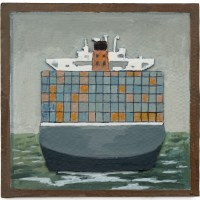
Contributed by Bill Arning / Long-time Bosman watchers often recall his work as a firehose of imagery—gunfights and car chases, sinking ships, kidnappings, and robberies pouring out in rapid succession. Fans might therefore be surprised when entering his first solo show at Kingston’s beloved Headstone Gallery, a venue known for its ambitious program of younger artists. In inviting an older master like Bosman, the gallery has delightfully broadened its scope.
LA PST Report: Toward better social behavior
Contributed by Peter Plagens / The first edition of the Getty-sponsored “Pacific Standard Time” slate of exhibitions in 2011 was subtitled simply “Art in L.A., 1945 – 1980,” and it aimed to elucidate Southern California’s contribution to American postwar modern art. In 2017, the second iteration was called “LA/LA,” indicating the city’s Latin American art and artists. This time around PST has declared a more specific theme, “Art and Science Collide,” reminiscent of one of those noble Rose Parade rubrics…
Elias Wessel: Exposing social media
Contributed by Chunbum Park / At Picture Theory in Chelsea, Elias Wessel has assembled provocative installations titled “It’s Complicated” and, with composer and musician Natalia Kiёs, “Systems at Play.“ In “It’s Complicated,” busy photographs that document surfing and scrolling behavior stand on pedestals. Holstered at their sides are headphones piping cacophonic sounds and words – styled “Is Possibly Art” – that AI-based text-recognition software has distilled from the long-exposure images.
Jo Baer: Space, position, and light
Contributed by David Carrier / Five smallish early Jo Baer paintings are on display in one white- walled gallery at DIA Beacon in her exhibition there since 2022. The show is both tantalizing and exasperating. In the 1970s, Baer became famous as a minimalist painter. Then she left New York, published a manifesto in 1983 proclaiming “I am no longer an abstract artist,” and changed her style completely.
Beatrice Caracciolo: Exquisitely stealthy
Contributed by David Carrier / What does it mean for a contemporary artist to be inspired by an older text or artwork? The Gospel of Matthew 15:14 says: “If the blind lead the blind, both shall fall into the ditch.” Moved by those words in 1568, Pieter Bruegel the Elder painted The Blind Leading the Blind, which hangs in Museo di Capodimonte in Naples. Now stirred by that picture, Beatrice Caracciolo, a young artist who grew up in that city, has drawn The Blind 16: one large image of the blind beggars and several smaller details also derived from the Bruegel. Between Matthew and Bruegel and then Bruegel and Caracciolo, there’s a kind of creative slippage whereby the meaning of the prior statement is transformed. At each stage, Matthew’s basic conception is partly preserved while something is added or subtracted. He doesn’t specify, for instance, that there are six blind men. Caracciolo shows his entire work, but without color, in grisaille. In smaller rectangular works on paper, she focuses on the trees and on some of the individual blind men.
Past, present, and future: The complementary visions of Jodi Hays and Michi Meko
Contributed by Jenny Zoe Casey / In a fascinating and inspired pairing, “The Burden of Wait” at Susan Inglett brings together painters Michi Meko and Jodi Hays and explores the different ways in which inhabitants of a particular region – here the American South – can experience it. Landscape is an important influence for both artists, but their approaches are mostly in opposition.
Elisabeth Condon: Beautiful complexity
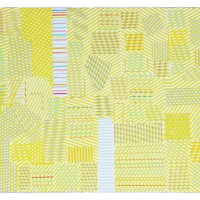
Contributed by Sharon Butler / To understand Elisabeth Condon’s paintings, it seems important to know that she grew up in California in a highly decorated house where she spent hours staring at the wild patterns of the fabrics and wallpapers. The experience certainly informs her exuberant paintings, in which pattern, flower, landscape all co-exist, as she says in her artist statement, in living, breathing presence.
Surface, flourish, complexity at the Hessel Museum
Contributed by Anne Swartz / Since its origins in the 1970s, practitioners and advocators of the Pattern and Decoration movement have countered claims that decorative art lacked seriousness. In America at the time, critical arguments focused on the exhaustion of painting, positioning it as an outmoded visual form. Several artists resisted this affront. Instead, they embraced images for their pleasure, opposing the notion of immediacy often considered synonymous with other mediums such as photography.
Armin Kunz: Presentism and art history
Contributed by Armin Kunz / �Can we ever look at Titian�s paintings the same way again?� asked Holland Cotter when he reviewed the reunion of […]
Scene + Sensoria
Scene + Sensoria will be a regularly occurring project of capture, of both the social and aesthetic dimensions of the New York art world, towards […]
Les Gommes: Becky Brown and Annette Cords at PS122
Contributed by Axel Bishop / In a collaboratively constructed two-person exhibit at PS122, Brown and Cords experiment with the interplay of image-experience vs. knowing through written language.
The stories we choose to tell: “Fall Reveal” at MoMA
Contributed by Laurie Fendrich / The Museum of Modern Art�s �Fall Reveal� marks the second phase of the museum�s re-telling of the story of Modern […]
Artist’s notebook: Louise Belcourt
New York-based painter Louise Belcourt recently returned from a quiet summer in the country, where she completed new work, which is on view through December […]
Finding Esphyr Slobdokina
Contributed by Peter Plagens / When the annual The Armory Show art fair — which takes place on the piers on the Hudson River in […]
Catalogue essay: Abstract Art Does Not Stop an Hour
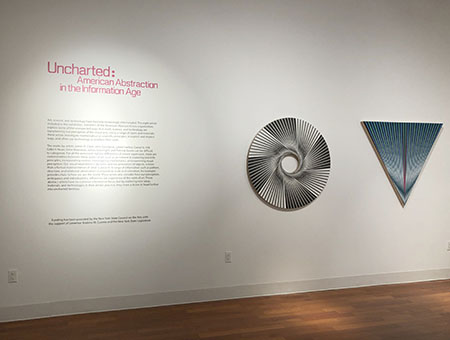
Contributed by Laurie Fendrich / The works in Uncharted: American Abstraction in the Information Age are, for all their reliance on what we call “technology,” […]
Eric N. Mack and Vivian Suter: How to fill a space
By Kristen Clevenson / Eric N. Mack‘s exhibition “Lemme walk across the room“ at the Brooklyn Museum and Vivian Suter�s eponymous show at Gladstone Gallery are ostensibly […]
Catalogue essay: Paul Pieroni on Peter Halley’s 1980s painting
The aim of this text, which was originally published as “Facts are Useless in Emergencies” in Peter Halley: Paintings of the 1980s The Catalogue Raisonne, […]
Vija Celmins: To fix the image in memory
Contributed by Laurie Fendrich / Anyone walking out of the Vija Celmins retrospective that opened last week at SFMoMA thinking how good she is at […]