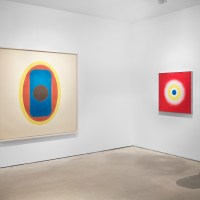
Contributed by Alex Grimley / In the 1972 documentary Painters Painting, Kenneth Noland is asked by director Emile de Antonio, “What does ‘color field painting’ mean?” The plainspoken artist thinks for a second before answering, “What they generally mean, I think, is that the painting is mostly generated by color, rather than, say, drawing or any other means.” Noland’s matter-of-fact response is indicative of his feeling about such terminology. Labels coined in the 1960s like “color field painting” and “post-painterly abstraction” – “a fairly awkward term,” he remarked – circumscribed his art, categorizing it alongside that of painters like Helen Frankenthaler and Jules Olitski, artists whose aims increasingly diverged from Noland’s. “Kenneth Noland: From Center to Edge,” currently on view at Hunter Dunbar Projects, is a concentrated presentation that illustrates the considerable range of the artist’s practice over four decades, from the 1960s to the early 2000s.
Search Results for "label/Artists Space"
Ted Stamm’s conceptual adventurism
Contributed by Saul Ostrow / When Ted Stamm’s career was cut short by his death at age 39 in 1984, he had already begun to attract attention in the United States and internationally. Critics including Edit deAk, Peter Frank, Robert Morgan, and Kay Larson recognized Stamm’s ability to bridge formal rigor with playful urban references. In 1975, deAk wrote in Artforum that “Stamm’s work confounds its own apparent simplicity; the shape’s tense complexity and stubborn definition of itself make it totally the artist’s like an insignia. The color is equally personal, and the painting’s presence is quietly assertive. This is certainly not the elegant nihilism of reductive solutions.” Conceptual endeavors were central to his ambition of making the border between art and everyday life porous.
The new Frick: A somewhat sentimental reaction
Contributed by David Carrier / Rebuilding seems to be a cyclical occurrence for older art museums. The collection expands, styles of display change, more capacious restaurants and shops may be needed. Older museums have to construct new galleries. To the original European galleries, entered atop the stairs at the entrance, the Metropolitan Museum of Art added space for Islamic art, contemporary work, and Asian paintings. Alternatively, a wealthy museum can rebuild almost from scratch, as MoMA has repeatedly done. Yet, for most of the time I have been going to art museums, New York’s Frick Collection has been basically unchanged, an island of stability. I remember once being shocked that one of its masterworks – Rembrandt’s The Polish Rider – was away on loan. No other major New York art institution has remained basically the same over such a lengthy period, celebrating idiosyncratic displays that mix sacred and secular works in a luxurious setting. Henry Clay Frick had a great eye.
Corriero, Segre, Seidl: Open, enveloping, searching
Contributed by Michael Brennan / I have long admired the work of the three artists Michelle Segre and Guy Corriero, whose work is now on display at “Fly like a Flea, Sink like a Stone” at Springs Projects, as well as Claire Seidl, whose show “Days Like These” is up at Helm Contemporary.
Jo Baer: Space, position, and light
Contributed by David Carrier / Five smallish early Jo Baer paintings are on display in one white- walled gallery at DIA Beacon in her exhibition there since 2022. The show is both tantalizing and exasperating. In the 1970s, Baer became famous as a minimalist painter. Then she left New York, published a manifesto in 1983 proclaiming “I am no longer an abstract artist,” and changed her style completely.
Past, present, and future: The complementary visions of Jodi Hays and Michi Meko
Contributed by Jenny Zoe Casey / In a fascinating and inspired pairing, “The Burden of Wait” at Susan Inglett brings together painters Michi Meko and Jodi Hays and explores the different ways in which inhabitants of a particular region – here the American South – can experience it. Landscape is an important influence for both artists, but their approaches are mostly in opposition.
Elisabeth Condon: Beautiful complexity
Contributed by Sharon Butler / To understand Elisabeth Condon’s paintings, it seems important to know that she grew up in California in a highly decorated house where she spent hours staring at the wild patterns of the fabrics and wallpapers. The experience certainly informs her exuberant paintings, in which pattern, flower, landscape all co-exist, as she says in her artist statement, in living, breathing presence.
Scene + Sensoria
Scene + Sensoria will be a regularly occurring project of capture, of both the social and aesthetic dimensions of the New York art world, towards […]
Cezanne’s pursuit
If theres one word that sums up Paul Czanne (1839-1906), the subject of this massive MoMA exhibition, its struggle.
Les Gommes: Becky Brown and Annette Cords at PS122
Contributed by Axel Bishop / In a collaboratively constructed two-person exhibit at PS122, Brown and Cords experiment with the interplay of image-experience vs. knowing through written language.
The stories we choose to tell: “Fall Reveal” at MoMA
Contributed by Laurie Fendrich / The Museum of Modern Art�s �Fall Reveal� marks the second phase of the museum�s re-telling of the story of Modern […]
Eric N. Mack and Vivian Suter: How to fill a space
By Kristen Clevenson / Eric N. Mack‘s exhibition “Lemme walk across the room“ at the Brooklyn Museum and Vivian Suter�s eponymous show at Gladstone Gallery are ostensibly […]
Catalogue essay: Paul Pieroni on Peter Halley’s 1980s painting
The aim of this text, which was originally published as “Facts are Useless in Emergencies” in Peter Halley: Paintings of the 1980s The Catalogue Raisonne, […]
Exhibition essay: Sarah Sentilles on Nancy Bowen at Kentler International Drawing Space
Contributed by Sarah Sentilles / Nancy Bowen calls herself an “artistic archaeologist,” and in her exhibition “For Each Ecstatic Instant,” you can see the fragments […]
A better bonfire at the Whitney: Painting from the 1980s
Contributed by Jonathan Stevenson / “Fast Forward: Painting from the 1980s,” the Whitney’s trenchant exhibition of American work, immediately recalls the Reagan era, when bluffness […]
The gap between: “Unfinished” at the Met Breuer
Contributed by Sharon Butler / In recent years, artists have been interested in “slippage.” In painting, that often translates into an exploration of the space […]
Web world: The New Museum’s 2015 Triennial
Entering the New Museum’s 2015 Triennial “Surround Audience” is like stepping into someone else�s search history. If you�re passionate about the same information that he […]
“If wall text leaves us feeling neither more informed nor more enthused, it�s just visual junk.”
At Frieze, Hayward Gallery curator Tom Morton considers museum wall text. “Major museums and galleries provide wall texts because of three problems � or, at […]
Painting strategies at the 2012 Whitney Biennial
The 2012 incarnation of the Whitney Biennial features (in addition to a huge slate of film and video screenings in a side room and performance on […]
Helen Frankenthaler: More profound than lyric
After seeing the exhibition at Gagosian, I’ve become a huge Helen Frankenthaler fan. Curated by John Elderfield, Chief Curator Emeritus of Painting and Sculpture […]