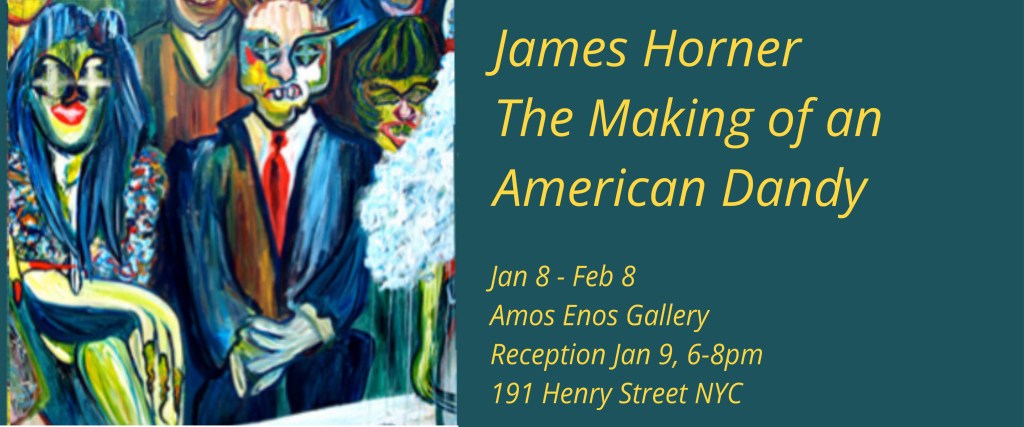
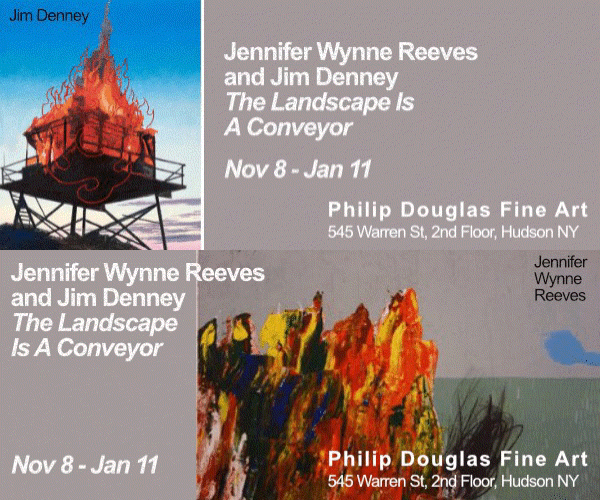
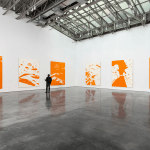
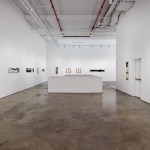
Contributed by Sharon Butler / Because of you, Two Coats of Paint will continue to thrive in 2026. Your contributions will enable us to continue producing these painting-centric monthly gallery guides that help the painting community discover exhibitions in New York City, the Hudson Valley, and beyond. Cheers to another year of great art, great writing, and great community, despite the dark days ahead….
Latest articles
Precision in play at Flinn Gallery
Contributed by Jacob Cartwright / True to its title, the group show “Precisely.” at Flinn Gallery is chockablock with precision-crafted paintings. There is an equal […]
Hudson Valley (+ Vicinity) Selected Gallery Guide, January 2026
Contributed by Karlyn Benson / Happy New Year! January is a quieter month in the Hudson Valley, but there is still plenty of great art to see around the region. From north to south, Barbara Todd: Undoings opens at Opalka Gallery in Albany on January 20. Three solo shows open at Catskill Art Space in Livingston Manor on January 17: Richard Barlow, Lisa Craft and Ellen Driscoll. Yura Adams’ solo exhibition Marvel’s Cabinet opens at WAAM in Woodstock on January 23. At the Millbrook Library The Color of Growth with Irja Bodén, JoAnne Lobotsky, Patrick Neal, and Colin O’Con opens on January 9, and on January 10, a two person show with Susan English and Laura Moriarty opens at Kenise Barnes Fine Art in Kent, CT and CRAZY, a group show curated by Jaime Ransome opens at BAU in Beacon. Also on January 10, Boundaries: Beth Dary, Amy Kupferberg, Rita Maas, and Mary Negro opens at Yellow Studio in Cross River, NY.
Susanna Tanger: 50 years around Mulberry Street
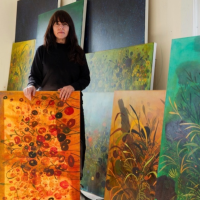
Contributed by Natasha Sweeten / A few winters ago, in a small town upstate, I met my neighbor, the artist Susanna Tanger. She’d invited me for tea, and as we got to know each other I felt grateful to have a kindred spirit nearby. Her paintings seemed to grow from concentrated, layered planes of light, the soft colors humming and communing with river vistas framed by her studio windows. Our neighborship was brief. Susanna returned full-time to her Soho loft, where she’s lived and worked since 1975. But her short biography seemed compelling: she’d arrived in NYC in her early twenties to a burgeoning art community, maintained a studio practice, and raised two children as a single parent. I had the urge to learn more about her.
Ana Benaroya: Sexual politics burlesque
Contributed by Aaron Michael Skolnick / Ana Benaroya’s solo exhibition “Eternal Flame” at The FLAG Art Foundation is a joyously absurd exploration of the female body and masculinity. As a child of the ‘90’s making my way from room to room bouncing between fields of color and exotic scenarios, I can’t help but think about the burlesque quality of American Gladiators and the World Wrestling Federation’s images of women. But Benaroya is also serious about sexual politics.
A penchant for belonging: Biala’s Paris
Contributed by Rebecca Allan / Just off rue de Jarente in the Marais, Galerie Pavec – which late last year presented “L’Esprit Français,” the first […]
Lee Tribe: Between paint and steel
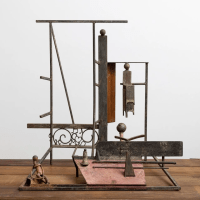
Contributed by Laurie Heller Marcus / Paint on sculpture can disrupt our spatial savvy, challenging habits of looking we bring to the interpretation of form. Lee Tribe plays with them in a variety of ways in his current show “Catching the Sun” at Victoria Munroe Fine Art. As a sculptor, he’s played the long game. Trained at a young age as a welder in the shipyards of his native England, Tribe later studied at St. Martin’s College of Art with Anthony Caro and William Tucker, a long-time friend and mentor. After moving to the United States, he immersed himself in painting, noting how marks move the viewer through the composition of an image.
Will Kaplan: Stacking time
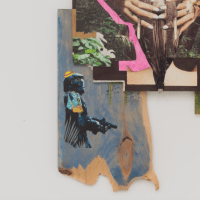
Contributed by Kate Sherman / On a freezing night earlier this month, I visited the opening of “Respawn,” Will Kaplan’s first solo show at D.D.D.D. gallery. The gallery recently traded its tight space in a Chinatown walk-up for a large, sweeping basement with a nook near the entrance, which houses Kaplan’s show. Five sizable works built primarily of wood are cleated to the walls and face the center of the room, where a provisional pedestal supports a clearly handbound notebook. Across the face of each wooden form, imagery sourced from printed matter is layered into dense collages. Kaplan’s vintage aesthetic held me back from apprehending the profusion of images present as a facsimile of our contemporary mediascape.
Robert Storr, at the margins
Contributed by Marjorie Welish / Robert Storr’s canvases are designed to counter expectations and require us to discard habitual taste. Disequilibrium reigns in abstract compositions exploiting the inexhaustible potential of the basic unit of the square. To keep the viewer alert, he employs novel moves and tactics, inserting an eye-catching red block within otherwise black and white interlocking compositions. But Storr’s paintings, on view at Vito Schnabel through January 17, are not about color, or even about perception and finesse bestowed to a surface. Rather, color for him is a signal to attend to a structural remit for composition.
Diebenkorn at Gagosian: A remarkable curatorial accomplishment
Contributed by David Carrier / For a long time, I have always thought of Richard Diebenkorn as a great painter. A couple of his paintings were in my local museum, the Carnegie Museum of Art in Pittsburgh, where I treasured seeing them. But he was, so I believed, someone whose development was straightforward, even a little boring. I arrived at Gagosian’s large upstairs gallery on Madison Avenue with low expectations of a thick array of Diebenkorns in that one room. Maybe it had been a mistake, inspired by misguided nostalgia, to take on this assignment. In the event, the exhibition was revelatory, holding me spellbound. This is one reason why I love being an art critic – the surprise.
Rob Lyon’s storm-free world
Contributed by Peter Schroth / Anyone with an aversion to charm might want to sidestep Rob Lyon’s seductive show at Hales Gallery. Those seeking a diversion from the world’s traumas may find a refuge there. From Sussex, England, the artist finds his inspiration in the local landscape – a common point of reference for modern British painters. Their ghosts and others’ are clearly traceable here. Indications emerge of several additional painting traditions. Lyon borrows freely from his British forbears – note his use of rosy sand and faded blues in line with their penchant for muted palettes – but also from the Cubists and Giorgio Morandi.
Artist’s notebook: Sage Tucker-Ketcham
On her return as a Two Coats of Paint Resident Artist, we invited Sage Tucker-Ketcham to contribute an “Ideas & Influences” column. With roots reaching back fourteen generations in Vermont, Sage transforms daily walks into botanical compositions based on her memories of observed wildflowers and native vegetation. She is particularly interested in overlooked plants that she finds in unexpected places. Sage will be in residence from Sunday, January 4 through Friday, January 9, 2026. Please join us for an Open Studio on Wednesday, January 7, from 5–7 PM.
palladium/Athena Project: Democratizing art
Contributed by Mary Shah / Greg Lindquist and Theresa Dadezzio, co-founders of palladium/Athena Project, just opened their inaugural show, “Works on Paper,” featuring an impressive 175+ artists at their new curatorial space in Greenpoint, Brooklyn. I sat down and talked with Theresa and Greg about the project.
Kylie Heidenheimer’s ecstatic dissonances
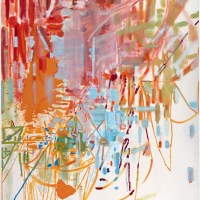
Contributed by Bill Arning / Private Public Gallery has earned its reputation for mounting deeply considered exhibitions of painting that honor artists who have spent decades refining their own private grammars of mark and color. Entered through a small garden – an architectural prelude that feels almost ceremonial – the gallery offers a perfect threshold for work that rewards slow, attentive looking. “Here, Elsewhere,” Kylie Heidenheimer’s first solo exhibition there, is fully in that lineage.
Matthew Miller: Hand to a humble god
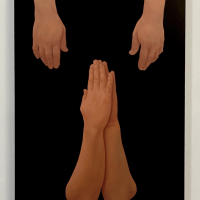
Contributed by Jonathan Stevenson / For over twenty years, Matthew Miller rendered arduously meticulous yet mysteriously otherworldly portraits, mainly of himself as subject and almost always against a maximally opaque black background betraying no brushstrokes, evidently free of human imperfection.